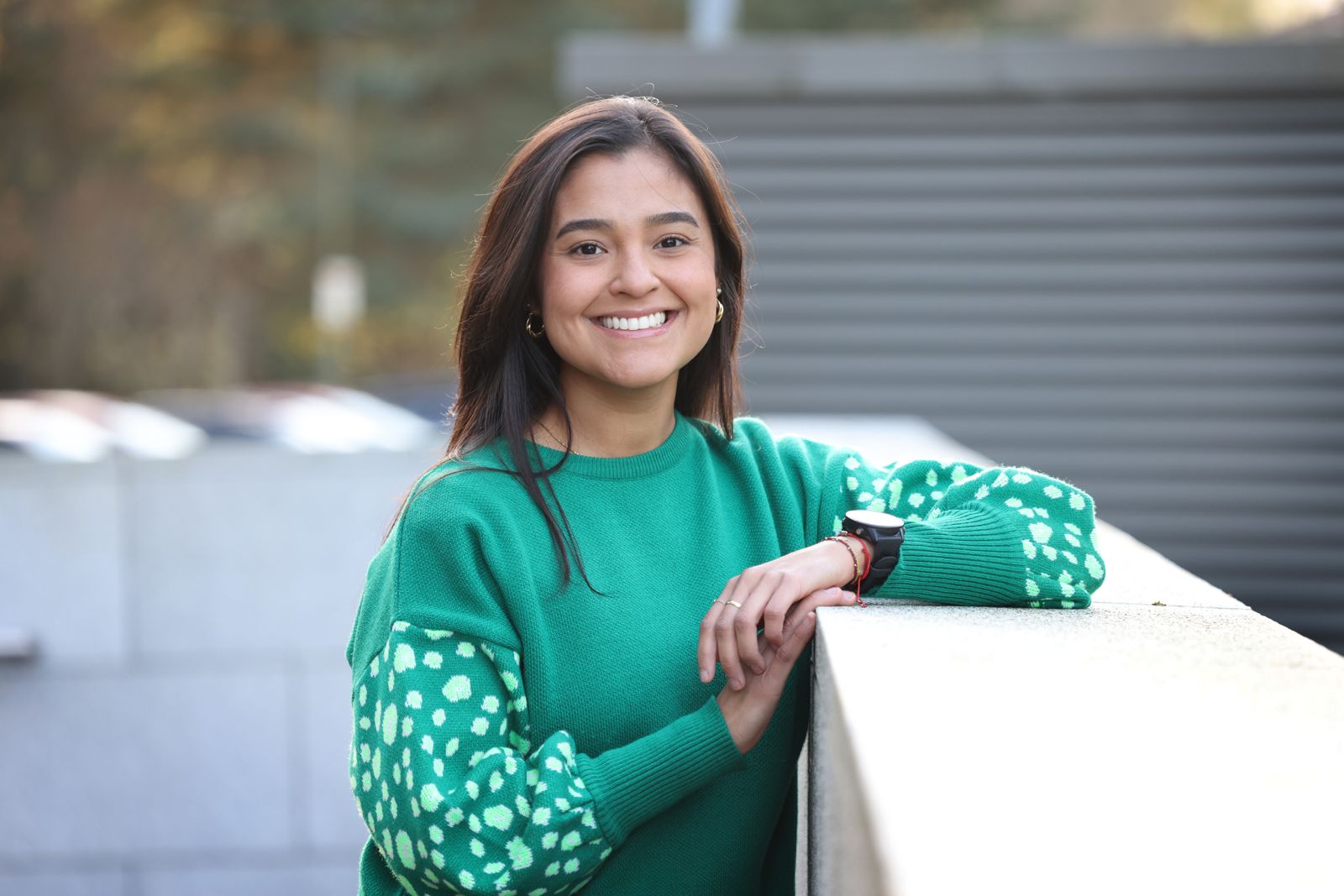
Isabel Meza Silva, programme manager of the STEM Passport for Inclusion at the National Centre for Inclusive Higher Education in Maynooth University, brings an engineering background and first-hand industry experience to a national programme designed to widen access to STEM education and careers, including those within construction and the wider built environment. She talks to AIDAN PRIESTLEY, about the power of mentorship
Isabel Meza Silva studied industrial engineering in Colombia, inspired by her father’s career in manufacturing. She says her interest in the sector began early. “My dad was an industrial engineer and he worked in a factory where my favourite cereal was made. When I visited the factory, I fell in love with how things are made.”
That early exposure shaped her understanding of industry and led her to pursue engineering as a profession. At university, she specialised in operations research, production and logistics. As part of her studies, she completed her thesis with a concrete company, where she became acutely aware of gender imbalance within industrial settings.
“It was strange to be one of the only women in the plant,” she says. “Even when I focused on production and logistics, there were very few females going into manufacturing.”
Her move to Ireland began with an internship at Irish Manufacturing Research as a data analytics intern. The organisation works with manufacturing companies to introduce advanced technologies and improve processes, helping to challenge traditional perceptions of the sector.
Isabel later returned to Colombia to complete her degree before relocating to Ireland as a full-time data analytics researcher. Working within advanced manufacturing reinforced her belief that many people have a limited understanding of modern industry.
“When people think about factories or construction, they imagine manual, repetitive work,” she says. “What they do not see is the designers, software engineers and data specialists behind it.”
She believes this lack of visibility plays a major role in limiting diversity across STEM and construction-related careers. Alongside her technical role, she remained actively involved in education and outreach.
Through Science Week and Engineers Week, she supported programmes for primary and secondary schools, later leading funded initiatives in 3D printing, robotics and coding across several regions.
This work marked a turning point in her career and helped her combine engineering with education. She says this shift became deeply personal following the death of her father in 2016.
“Working in education and promoting STEM, manufacturing and women helped me transform that grief into something meaningful,” she says.

Isabel now leads the STEM Passport for Inclusion programme, which was established in 2021 to address inequality in access to STEM education. Developed by Professor Katriona O’Sullivan, in collaboration with Microsoft, Research Ireland, the Department of Education and Youth, the programme focuses on students from underserved backgrounds, particularly female students in DEIS schools.
“The aim is to provide students, regardless of background, with access to high-quality STEM education,” she says. The programme is structured around four pillars. The first is skills, delivered through a Level 6 university-accredited module covering coding, data science, artificial intelligence and design thinking. Students graduate through one of five university partners.
The second pillar is role models. “Every student meets a mentor from industry,” she says. “They might be engineers, technologists or working in HR, finance or marketing within a STEM organisation.”
The programme currently works with over 600 mentors. The third pillar focuses on pathways into higher education. Students can access up to 60 CAO points across designated STEM courses within partner universities, helping to bridge what she describes as “the gap between STEM potential and STEM success”.
The fourth pillar is work experience, introduced in response to barriers faced by students without established networks.
“Work experience often depends on who you know,” she says. “These students do not always have those connections, so we act as the link between them and industry.” Since September, over 450 students have completed placements through the programme.
Isabel believes the programme is highly relevant to construction, where demand for technical and analytical skills continues to grow. She stresses that STEM education does not limit career options. “STEM does not mean you have to be a builder or a manufacturer,” she says. “The skills are transferable across sectors.”
She continues to rely on both technical and soft skills developed during her engineering career, including data analysis, decision-making, problem solving and resilience.
“Engineering teaches you to stay calm when problems arise and to keep trying when something does not work the first time,” she adds. Her advice to students entering STEM is direct.
“Ask for help,” she says. “Teachers, mentors and employers want to support you, but you have to feel confident enough to ask.”
Isabel believes creating inclusive, supportive environments is essential for building a sustainable and diverse future for construction and STEM industries.