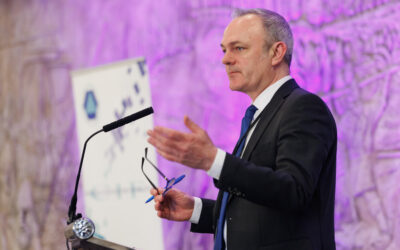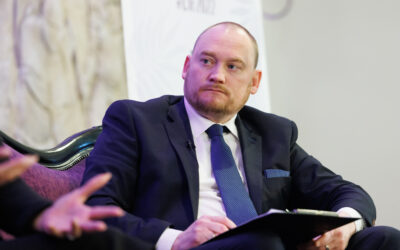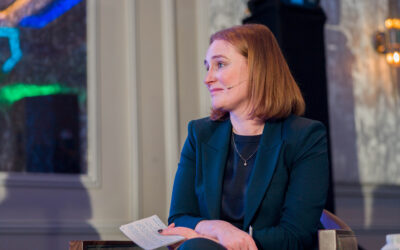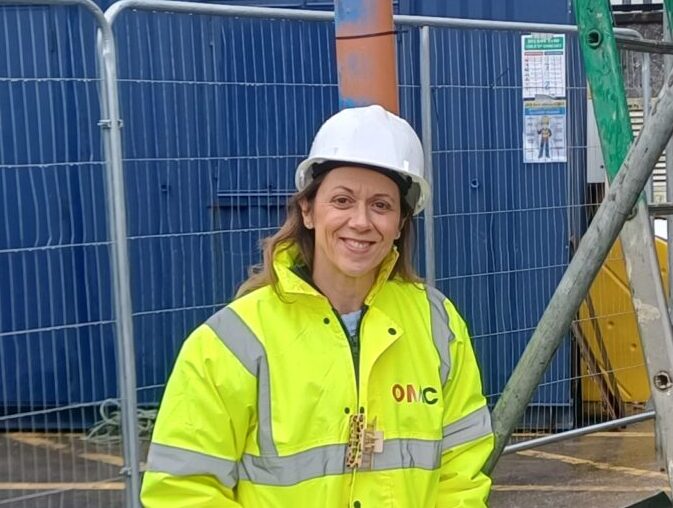
Niamh McNulty is the Director of Health and Safety at OMC. Her journey into the industry was neither linear nor planned, but it has shaped a professional perspective grounded in experience, credibility and respect for those working on site. Ahead of a keynote address at this year’s CIF International Women’s Day Summit, she tells AIDAN PRIESTLEY about the importance of continuous learning
At school, Niamh McNulty’s interests lay between medicine and languages until, she recalls, being ‘invited’ to no longer participate in chemistry class. “So that was medicine gone down the road,” she says. Languages then.
Niamh studied International Marketing and Languages at Dublin City University, graduating in the mid-1990s with a jobs market that had yet to experience the boom of the Celtic Tiger. She chose to take a year out in the States. She stayed for five.
Her language skills quickly came to the fore, employed within a week of her arrival engaging with workforces that were largely Hispanic, across sectors including manufacturing, fabric production and meat processing, first as a claims assistant before qualifying as a workers’ compensation claims adjuster.
As she progressed in her career, she wanted to focus on prevention rather than the aftermath. That decision led her to move into a proactive accident prevention role, a shift that would ultimately define her career direction.
After almost five years in the US, Niamh returned to Ireland and completed a master’s degree at NUI Galway. It’s at this stage that she “got a notion in my
head that I wanted to do construction”.
More than two decades later, she remains firmly embedded in the construction industry.
Niamh describes her approach to health and safety as progressive rather than traditional, and is a strong advocate for moving away from purely compliancedriven models towards approaches often described as Safety Differently or Safety II.
This philosophy emphasises psychological safety, a focus of systemic failure rather than ‘human error’ and engagement over rigid enforcement and headline metrics.
“We had twice as many fatalities last year as we had the year before within the industry, so something has got to change,” she says.
She believes the traditional policing approach to health and safety often alienates workers and creates resistance rather than cooperation. Instead, she believes safety must be something people genuinely understand and value, rather than something they tolerate.
“I think the industry needs to evolve and mature towards a new approach.”
Reflecting on her career, developed in male-dominated industries, she says her experience of gender bias has become more pronounced as she has progressed into senior roles.
“It is rampant within the industry, and the guys might not agree with that, but they’re not at the receiving end of it,” she says. “If, as an industry, we want to encourage more women to join us, I would encourage our male colleagues to reflect on this individually and collectively. The language we use can perpetuate gender bias, often marginalising women’s voices.”
Terms like ‘bossy and ‘emotional’, or worse, are frequently used to describe women in leadership, while similar traits in men may be perceived positively. She also highlights the importance of professional networks, particularly for those without family or social connections within construction.
“Don’t feel threatened by a strong woman. We don’t bite, not much anyway. We also won’t shrink for your comfort,” she adds.
On sites she describes a ‘benevolence bias’, as recent as last month. “I was on a site inspecting the certification date on a set of chains and of course the lads are there, offering to lift those for you,” she says. “I would never chastise somebody or dismiss them for coming from a good place, I take it in the spirit it was given,” she adds – in good faith and with genuine intention of support, an act that is almost chivalrous but it is still a bias that fails to recognise capabilities.
“Thankfully I am fit and healthy, and I am certainly capable.”
What emerges is Niamh’s own resilience in the face of the biases she has faced, and strengthened resolve to address it. Speaking to the leaders in the industry she says: “They have to listen but more importantly they have to hear what the women in the industry are telling them.” The response from male leaders in construction is often to withdraw or get defensive – ‘Not me, I don’t feel that way about women’.
Niamh returns to the point that “unless you’re on the receiving end of it, it’s very easy not to notice it”. “I appreciate that it is most likely not a conscious decision, discrimination and bias are two different things,” she says.
For women entering or progressing within construction, Niamh’s advice is practical. She stresses the importance of continuous learning, curiosity and developing a strong technical understanding of the sector. She says: “The more you can speak the language, the more credibility you have.”
Above all, she emphasises the importance of knowing one’s worth and maintaining a sense of self. She says it is easy to adapt too much to one’s environment “because it’s nearly a self defence mechanism that you become your environment, like a chameleon”.
“To succeed, don’t lose sight of yourself and your own personality, your own being.”