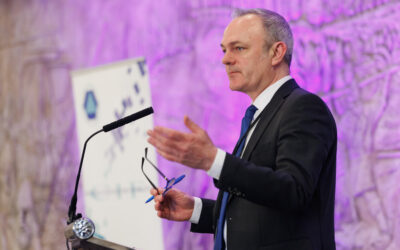
Ireland does not lack funding, capability or demand to build, says Stephen McCarthy, CIF President and owner managing director of Astra Construction Services Ltd in Cork. He believes a greater sense of urgency is needed across the system
Ireland’s construction industry stands on the threshold of a period of enormous opportunity for the country. The demand for housing, infrastructure and major national projects has rarely been greater, and there is strong capability within the sector to deliver.
Across the industry, companies are ready to invest, expand and play their part in supporting Ireland’s continued economic and social development. At the same time, there is no avoiding the fact that frustration has grown significantly within the sector over the past 12 to 18 months.
The gap between ambition and delivery remains too wide, particularly given the urgency surrounding housing and infrastructure. While there is widespread acknowledgement of the challenges facing the country, the pace at which projects move through Ireland’s bureaucratic system continues to create difficulties for contractors, developers and clients alike.
Many contractors continue to report lower than expected levels of activity, while the volume of projects emerging through the public procurement system has remained subdued. E-tenders this year have been noticeably slow despite the repeated emphasis on investment and delivery.
Capacity remains underutilised
For an industry being told there is significant funding available, there is a clear expectation that activity on the ground should now begin to accelerate. Importantly, this is not a question of industry capacity. The expertise, workforce and willingness to deliver already exist within the sector.
Construction companies across Ireland are prepared to mobilise, employ and deliver projects at scale. The concern is that too much of this capacity remains underutilised because projects are taking too long to move from policy discussions into active delivery.
There has been no shortage of plans, announcements and strategies in recent years. However, the industry increasingly needs to see those commitments translate into action. Construction ultimately depends on projects progressing to site and work commencing on the ground. Momentum and delivery are critical, not only for the sector itself but for the wider economy and society.
One of the greatest challenges remains the length of time it takes for projects to progress through the system.
Planning delays, judicial reviews, procurement timelines and growing compliance requirements can often add years before construction begins. While regulation and oversight are essential, the process has become increasingly complex and resourceintensive for both public and private sector projects.
This has significant consequences in an inflationary environment. Delays directly increase costs. A project postponed by a year can face substantial increases in materials, labour and financing expenses. If delays continue over several years, the overall cost escalation can become extremely difficult to manage.
In that sense, delivery and efficiency are not just operational issues, they are central to affordability and long-term value. Global economic uncertainty has added another layer of pressure. Rising borrowing costs, geopolitical instability and inflation continue to create challenges for contractors, particularly on fixed-price projects.
Time has become one of the biggest risks facing the industry. The longer projects remain delayed, the greater the financial strain on delivery.
The housing paradox
Housing remains one of the clearest examples of both the opportunity and the challenge facing the sector. Demand for homes is extraordinarily strong and there is broad recognition that increasing supply must remain a national priority. However, the private housing market, traditionally the foundation of delivery, continues to face considerable pressure.
Many smaller builders emerged from the recession financially weakened, while development finance today remains extremely expensive. Borrowing costs of 10 to 14 per cent create major difficulties for businesses seeking to deliver housing at scale.
At the same time, access to finance for smaller builders has become increasingly limited, despite the vital role these firms historically played in housing delivery across the country.
The regulatory burden on construction has also expanded significantly in recent years. Even straightforward planning applications now require extensive consultancy, compliance and procedural work before reaching approval.
While lessons from the past must always be remembered, there is a growing view across the industry that a better balance is needed between necessary oversight and the ability to deliver projects efficiently.
Optimistic mindset
Despite these frustrations, the outlook for the industry remains positive. Ireland continues to experience strong demand for investment in housing, infrastructure, energy, water, transport and digital development.
Few sectors are as central to the country’s future growth and competitiveness as construction. The opportunities ahead for the industry are significant. Construction has always been a resilient
and optimistic sector. It is an industry built on problem-solving, innovation and delivery under pressure.
There is no shortage of ambition, expertise or determination within the sector to meet the challenges ahead. What is needed now is a greater sense of urgency across the system. Ireland does
not lack funding, capability or demand.
The focus must now be on removing unnecessary delays, improving efficiency and ensuring projects can move from approval to delivery in a timely manner. The one message I would like to remind everyone though, is that our industry is needed now more than ever.
We simply must build the infrastructure required to deliver on our needs as a country. Everywhere you go we see the effects of under-investment in infrastructure. The next decade is a decade of delivery, a time where we simply must build more of everything.
A time where the skills knowledge and experience of everyone in this room will be needed more than ever.