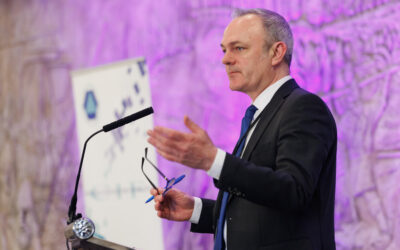
Pictured at the CIF’s Digital Construction Summit 2025 in October is Denise Tuffy, CIF Director for Specialist Contracting; Andrew Brownlee, CIF CEO; Emer Higgins, Minister of State for Public Procurement, Digitalisation and eGovernment at the Department of Public Expenditure, Infrastructure, Public Service Reform and Digitalisation and Sinead Cronin, CIF Administrator for Specialist Contracting. Picture by Maura Hickey
Emer Higgins, Minister of State for Public Procurement, Digitalisation and eGovernment at the Department of Public Expenditure, Infrastructure, Public Service Reform and Digitalisation, shares a viewpoint
Ireland’s population is growing, our economy is expanding and our communities urgently need new housing, transport, and social infrastructure. We all know the scale of the construction challenge before us. Meeting that demand requires us to build more efficiently, sustainably and transparently.
The Government’s commitment to this transformation is clear. Through the National Development Plan published this summer, we are investing over €275billion in public capital projects by 2035.
That figure represents the largest investment in capital projects in the history of the State – but investment alone isn’t enough. That’s why digital innovation is no longer a luxury in the construction sector; it’s a necessity.
From Building Information Modelling to Modern Methods of Construction to digital procurement tools, we are embedding the latest technology into every stage of infrastructure delivery.
The goal is simple: to deliver better outcomes – faster, more efficiently and more sustainably. As Minister with responsibility for Public Procurement, Digitalisation and eGovernment, I am keenly aware of the role of digital adoption and public procurement policy in providing greater certainty and value for money.
In doing so, we will be in a position to drive more efficient and evidenceinformed outcomes across our economy and society. The Build Digital Project, a key initiative under the Construction Sector Group, is helping to lead this charge.
One of its standout achievements is the development of BIM templates in collaboration with the Office of Government Procurement and the National Standards Authority of Ireland.
These templates are freely available and designed to help public sector bodies set clear, consistent digital requirements in their tender documents.
Since January 2024, all public works projects over €100million must include BIM requirements. This phased rollout will eventually apply to all publicly funded projects, ensuring a consistent, digital-first approach across the board.
As of July 2025, all projects with a value in excess of €10million that are entering Stage (i) of the Capital Works Management Framework must include BIM requirements in their scope.
Structured digital information is an essential enabler of the next phase of transformation in the built environment – addressing our carbon footprint. Without the data handling capacity of digital processes, we cannot accurately measure the carbon footprint of a construction project.
If we cannot measure this, we cannot verify that we are meeting our emissions reduction targets. My department is also developing a digital platform called eWorks, a pilot project which will focus on digitalising the Suitability Assessment Questionnaire.
This is the form used to assess whether contractors and consultants meet the necessary standards to work on public projects, and is currently a very time consuming and repetitive process.
By moving the SAQ and related documents online, we’ll save time, reduce duplication, and make the process much more efficient for everyone involved.
We have also upgraded the Capital Works Management Framework website to make it far more accessible and user-friendly for everyone who uses it, from government departments to local authorities and state agencies.
These examples reflect a broader shift towards digital transformation in public sector construction. But technology alone won’t deliver change. It takes leadership, collaboration, and a shared vision.
That’s why my department coordinates the Construction Sector Group. The group provides a structured forum for engagement between policy makers, industry and researchers to share ideas, align strategies and drive progress. Ireland’s construction sector is on the cusp of a digital revolution.
With the right tools, policies and partnerships, we can build infrastructure that not only meets today’s needs but sets the foundation for a more resilient, efficient, and sustainable future.