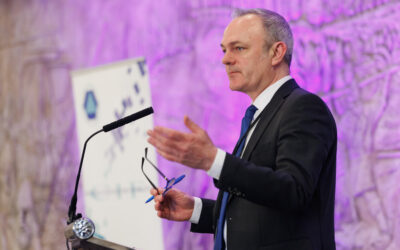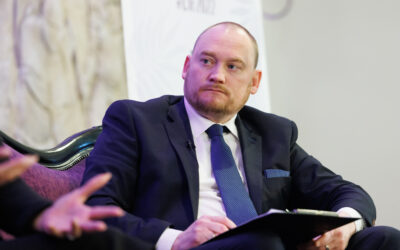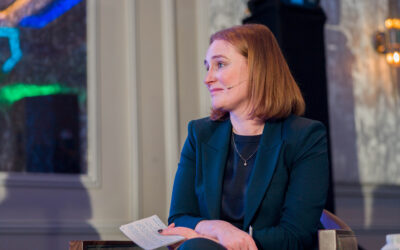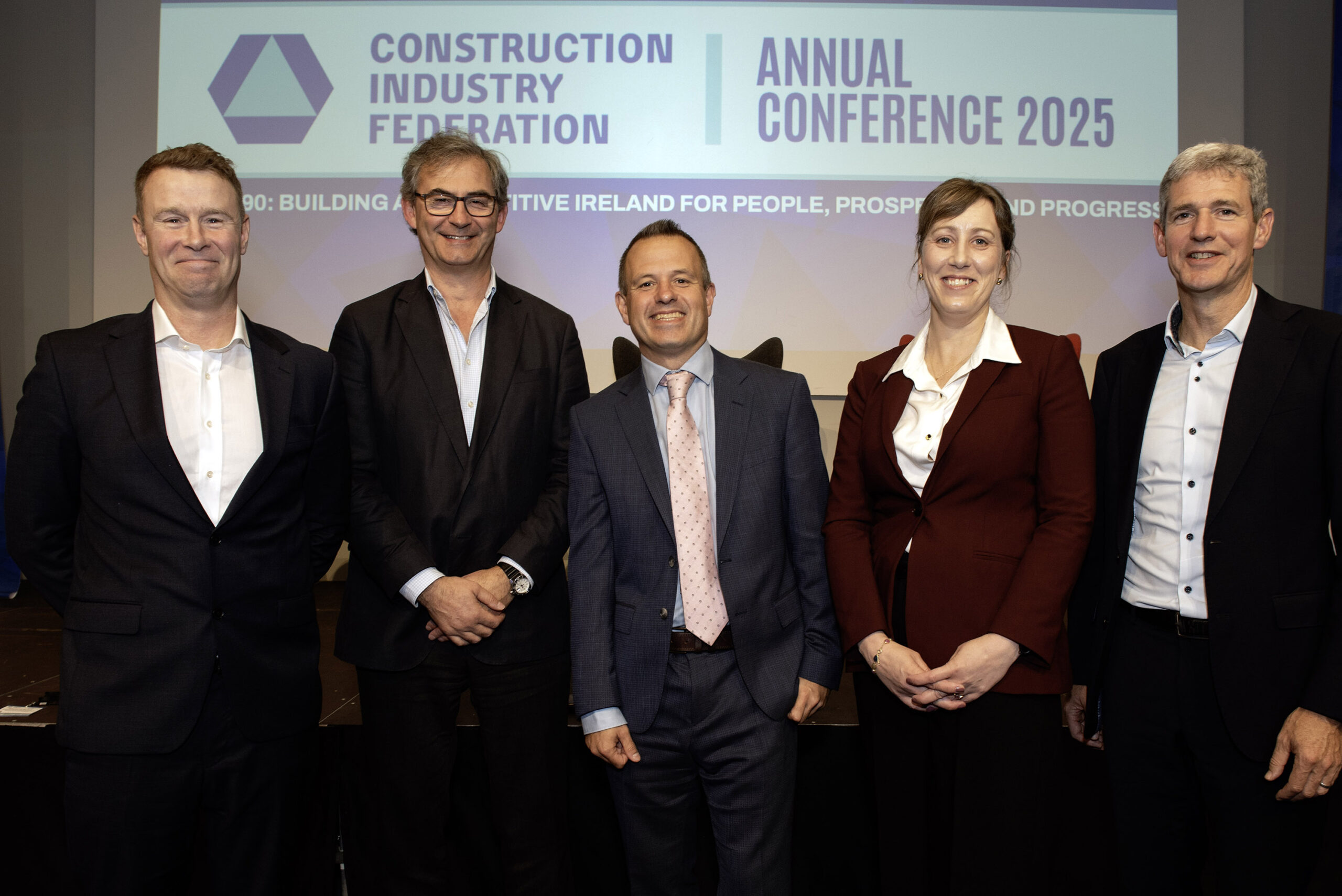
Pictured above is Jamie McGee, Partner, Construction Group, McCann FitzGerald LLP; David O’Brien, Officer, Department of Government Procurement (OGP); Andrew Brownlee, CEO, CIF, Sarah Murphy, Pre-Contract & Design Manager, Carey Building Contractors and Seamus Duggan, Joint Managing Director, Duggan Brothers. Pictures by Maura Hickey
The Construction Industry Federation marks 90 years, with the sector in a moment where optimism about meeting Ireland’s housing and infrastructure challenges is greater than ever, writes Quinton O’Reilly
Originally founded in 1935, the Construction Industry Federation (CIF) had grown to become one of Ireland’s most influential organisations, shaping modern Ireland. Nowadays, it brings together the best and brightest of the industry, culminating in the CIF annual conference.
It was a packed schedule to mark its 90th anniversary, held in Croke Park on Tuesday, September 30, with the day’s theme being Building a Competitive Ireland for People, Prosperity, and Progress. Opening the summit was chair Ivan Yates, entrepreneur and broadcaster, who highlighted the 40 speakers who would grace the stage, and mentioned the urgency of addressing both infrastructure and housing.
This paved the way for Taoiseach Micheál Martin to address the attendees. He spoke about how Ireland’s economy is in a strong position, and the time for action is now.
“From my perspective, this isn’t about publishing plans. It’s really about delivering in the work, removing the barriers and driving things on,” he said. “It’s to get delivering now, to create that sense of urgency within the planning frameworks, and deliver key infrastructure in the country, and we’re going to do it with your help.”
With those words in mind, it was then the turn of Stephen McCarthy, managing director of Astra Construction Services and president of CIF, to talk about 90 years of CIF, who summed up one of the day’s talking points by saying: “A plan without execution is only a pipe dream.”
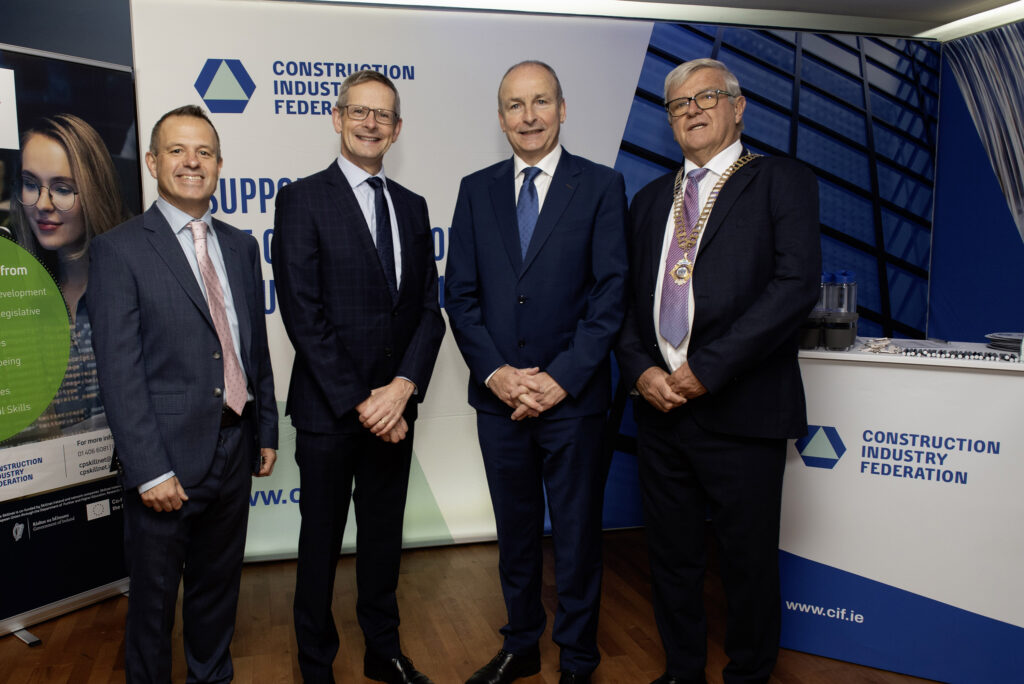
Andrew Brownlee, CEO, CIF; Hubert Fitzpatrick, Former Director General, CIF; Micheál Martin TD, Taoiseach and Stephen McCarthy, President, CIF and Managing Director, Astra Construction Services
The first fireside chat of the day saw Stephen Proctor, group leader of real estate and construction group at McCann FitzGerald, joining Yates on stage to speak about Ireland’s infrastructure future and creating certainty within the building sector.
He stated that collaboration and incentivising each relevant party was an important element to progress, saying: “A lot of people in this room understand that if you want to take risk, you have to reward it.”
The discussion of the day shifted toward Ireland’s viability as a robust and growing market for the construction industry, paving the way for the first panel session of the day. On stage discussing this topic were Alasdair Henderson, executive director at BAM UK & Ireland; Ger Ronayne, chief executive of JJ Rhatigan; Gillian Murtagh, director at Shay Murtagh; Liam Kenny, managing director of John Paul Construction; and Paul Brown, chief executive of Sisk.
When asked what the most important issue was, Alasdair Henderson replied: “Pipeline visibility, without a shadow of a doubt.”
Once concluded, the day shifted towards the conference’s first keynote address, focusing on unblocking barriers and accelerating Ireland’s infrastructure delivery. Imelda Mannion, member of the Accelerating Infrastructure Taskforce, spoke about how construction is one of the few industries that carries the national interest.
While the good news is that funding is no longer the constrictor to progress, the system, she said, is “too slow, fragmented and crippled by judicial reviews” and needs to change.
“There’s never been a better opportunity to get this right,” she said. “The political will and resources are aligned in a way we haven’t seen before… Delivery is the priority and this will only succeed if the response is cohesive.”
With a coffee break soon approaching, the early morning session concluded with a panel discussion on the pipelines that help drive industry growth. On stage were David Purdon, technical director of the autodesk division at NTI Diatec; Jeannette Mair, head of economic and policy research at CIF; Ronan Colleran, founder and managing partner at Azon Executive Search; Sean Downey, director of health and safety, education, training and skills at CIF; and Sinead Savage, business development director at McKeon Group.
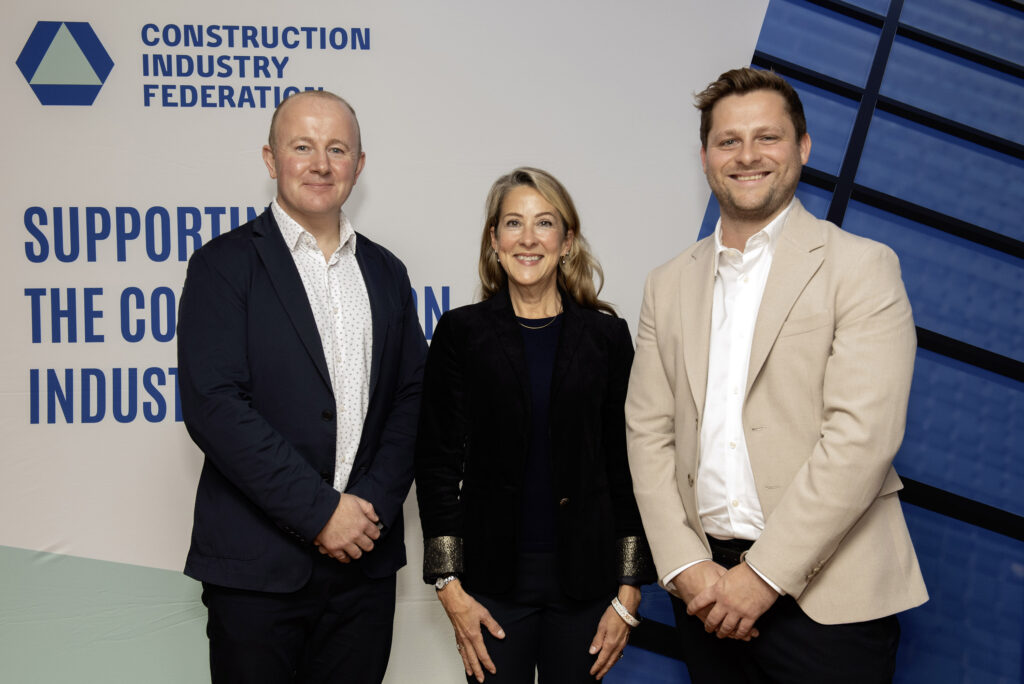
Jules Cantwell, General Manager – Europe, Procore; Stephanie Prenderville, Founder, SP Consulting and Will Grieveson, Senior Regional Commercial Director, SmartSheet
People at the centre
The crucial element in the pipeline is people, and having that at its core is vital if you introduce any new technological services or processes. “You have to see where your economies of scale are and the true way is to take 10 steps back and look at the whole process,” said Purdon. “It’s about utilising your people, and maximising your processes by having a fundamental understanding of the technology that drives it.”
With the audience returning to their seats, it was time to discuss the challenges in planning and consents, a constant topic within the industry.
First, Yates had a brief conversation with Andrew Brownlee, the incoming chief executive of the CIF, before bringing the next panel – on the challenges behind planning and consents – to the stage. Discussing this were Emer Uí Fhátharta, city planning officer at Dublin City Council (DCC); Geraldine Fitzpatrick, acting director of capital programme at Transport Infrastructure Ireland (TII); and Maria O’Dwyer, infrastructure delivery director at Uisce Éireann.
When asked what they would like from the industry, Uí Fhátharta mentioned that activating projects they have ready to go was crucial, while both Fitzpatrick and O’Dwyer encouraged the industry to engage with them and work together.
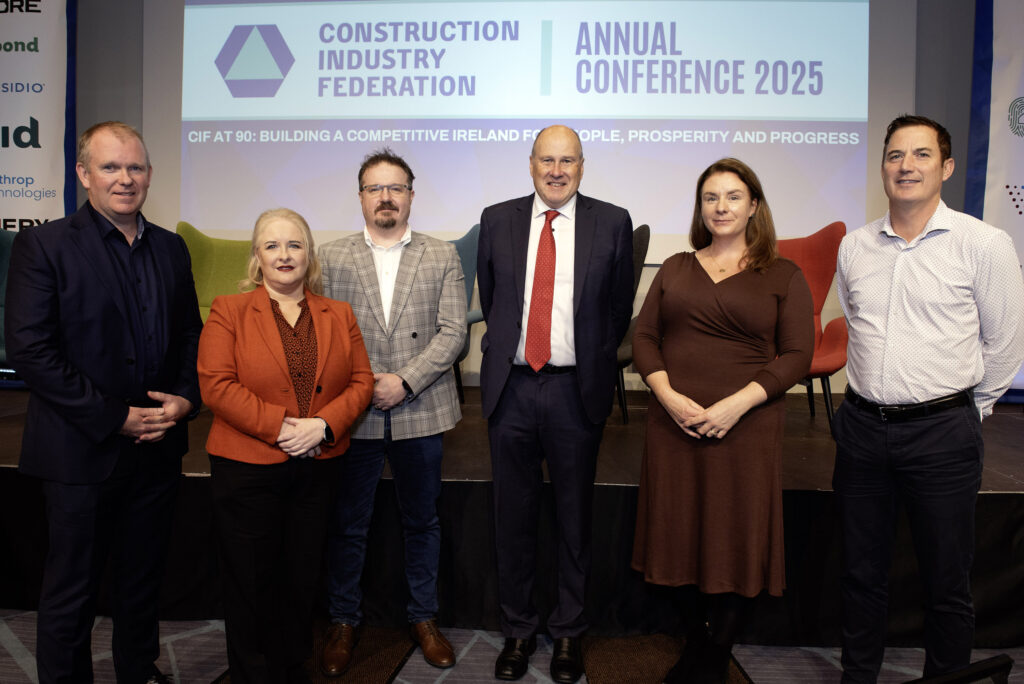
Sean Downey, Director of Health & Safety, Education, Training & Skills, CIF; Sinead Savage, Business Development Director, McKeon Group; David Purdon, Technical Director Autodesk Division, NTI Diatec; Ivan Yates, Summit Host; Jeannette Mair, Head of Economic and Policy Research, CIF and Ronan Colleran, Founder & Managing Partner, Azon Executive Search
Next up was an overview of the Construction Industry Register Ireland (CIRI), the statutory register for providers of building works in Ireland, delivered by Sarah Ingle, registrar at CIRI. The discussion moved on to procurement and risk with Paul Sheridan, director of main contracting at CIF, on stage to discuss the factors impacting how contractors manage design risk. His message was simple: ignore design at your peril.
“It’s important work that needs to be given the time and paid for appropriately to achieve it,” he said. “Get it right at the design outcome and you get a better construction outcome.” Before the lunch break, there was time for one more panel session detailing how to make public works contracts more attractive to contractors.
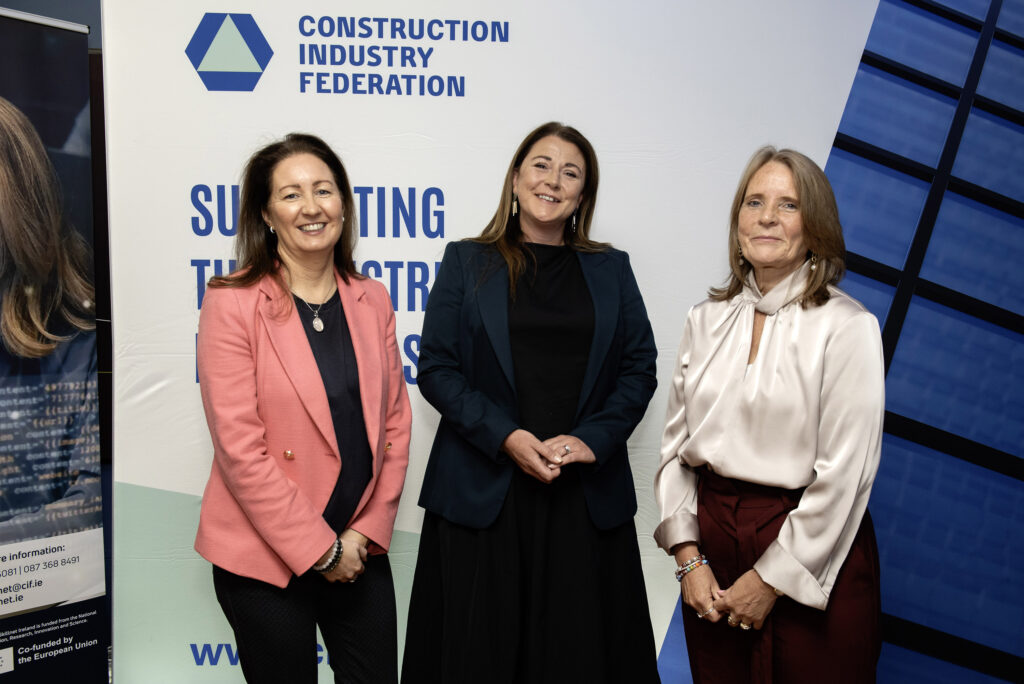
Maria O’Dwyer, Infrastructure Delivery Director, Uisce Eireann, Emer Uí Fhátharta, City Planning Officer, Dublin City Council (DCC) and Geraldine Fitzpatrick, Acting Director of Capital Programme, Transport Infrastructure Ireland (TII)
On stage were David O’Brien, principal officer for the Department of Government Procurement (OGP); Jamie Mc- Gee, partner of construction group at McCann FitzGerald LLP; Sarah Murphy, pre-contract and design manager for Carey Building Contractors; and Seamus Duggan, joint managing director of Duggan Brothers.
After detecting that the glass was half full from this panel discussion, McGee mentioned that collaboration is the key and that it needs to be incentivised for all parties. After lunch, the conference resumed by marking the end of an era. It was the last day for Hubert Fitzpatrick, who was stepping down from the role of director general of CIF.
He capped off his time by highlighting how hopeful he was for the industry, saying it “has the capacity to deliver the muchneeded infrastructure the country requires. Give the industry the policies and project certainty and it will certainly deliver.”
The next session, titled Building the Workforce of the Future, featured presentations from Katelyn Cummins, electrician for Alpha Drives and winner of the Rose of Tralee 2025; PJ Ryan, head of environmental, social and governance (ESG) at CIF; and Sandra Healy, chief executive and founder of inclusio.
Chatting with Yates, Cummins spoke about the importance of seeing role models at an early age, mentioning her recent trip to the Higher Options fair at the RDS and the presence of female apprentices there.
“I was seeing female apprentices there working, and I thought, if I saw this when I was in secondary school, it definitely would have pushed me on further,” she added. Next was Dermot Carey, welfare officer of CIF Benevolent Trust, who gave an update on the CIF Benevolent Trust before it moved onto a fireside chat with Eibhlin O’Connor, chief commercial officer for Clúid, who spoke about building sustainable and thriving communities.
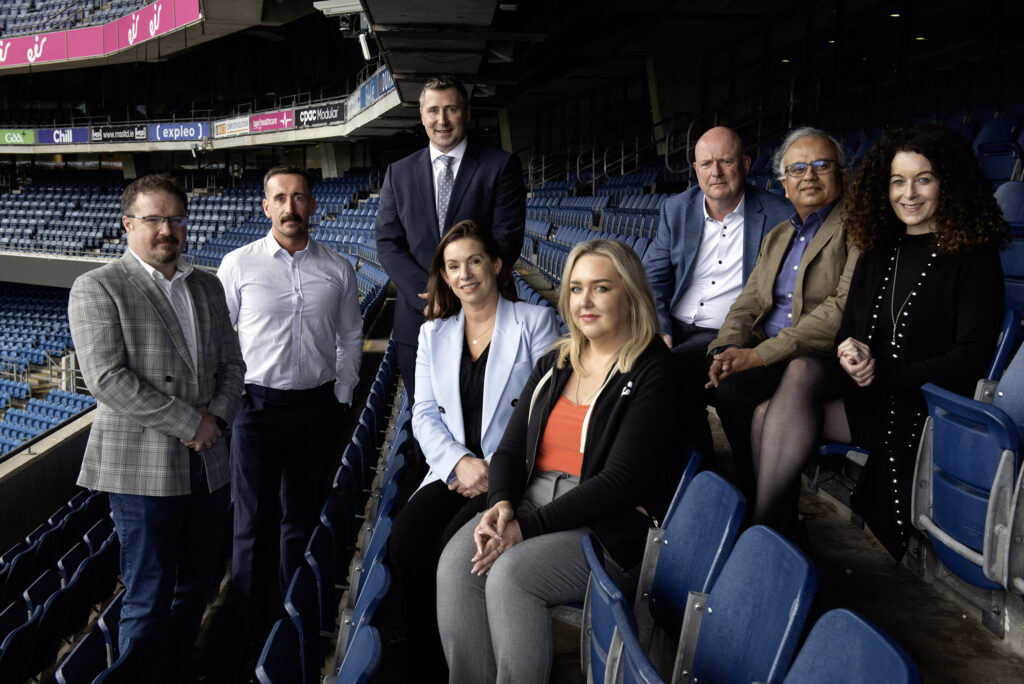
David Purdon, Technical Director Autodesk Division, NTI Diatec; Shay Cloherty, Director of Revenue, Experiences & Reader Revenues, Business Post; Stephen Proctor, Group Leader of Real Estate and Construction Group, McCann FitzGerald LLP; Eibhlin O’Connor, Chief Commercial Officer, Clúid; Lisa Murphy, Regional Events Manager, Growth Integrated Marketing Europe, Procore; Frank Brennan, Construction Director, BAM Ireland; Parag Joglekar, Director of Investment and Development, Respond and Ann Marie Whelan, Partner, Business Manager, HP Inc Ireland
Speaking about the procurement process, O’Connor described the traditional method as adversarial and how it has been changed through early contractor engagement. Before the conference closed, two more panel sessions remained. The first looked at funding for public housing with Conor O’Connell, director of housing and planning at CIF; Fiona Cormican, managing director for FionCor Consulting Ltd; John Coleman, chief executive of the Land Development Agency Ireland (LDA); and Parag Joglekar, director of investment and development at Respond.
When asked if organisations are competing with local authorities and jurisdictions in projects, Joglekar continued the theme of collaboration, saying that it’s never happened and there are clear protocols to ensure that continues to be the case.
The second panel discussed leveraging AI in construction planning – with Jules Cantwell, general manager Europe for Procore; Stephanie Prenderville, founder of SP Consulting; Tom Sadler, data science and AI solution lead UK for HP; and Will Grieveson, senior regional commercial director of SmartSheet – which placed people at the centre of all processes. Without that foundation, they agreed, any AI systems you integrate will fall apart.
Of the many developments happening in the AI space, Cantwell brought up agentic AI, which he described as a digital worker and how it requires a mind shift from all levels of an organisation, including senior management.
Finishing up the sessions was Annemarie Sheehan, partnership manager for Lighthouse Charity, who highlighted the valuable work it does to help mental health in construction.
It was then Yates who put a bow on the conference, taking time to wish Fitzpatrick a happy retirement while giving his closing remarks. “We learned the glass is half full, and that the government has promised us that we’re on the cusp of a new era of development.”