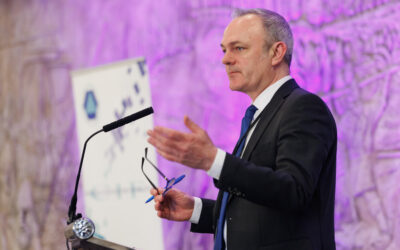
Conor O’Connell, CIF Director of Housing, Planning and Development Services, delivers an incisive overview of concerns affecting housebuilders across Ireland and what can be done to overcome these obstacles
The year 2026 has to be one for delivery. Over the past 18 months we have seen significant movement in housing policy.
Revised housing targets, updated apartment design standards, increased infrastructure allocations and the Budget announcement of a nine per cent VAT rate for apartment delivery have all reshaped the landscape.
Output rose by 20 per cent last year to 36,000 homes. That progress matters. But we have now reached a critical juncture. We have had the strategies. We have had the policy resets. We have had the announcements.
What we need now is implementation. The time for delivery is now. Decision-making must gather pace Many local authorities have recently published, or are about to publish, proposed variations to their development plans to reflect the revised housing targets issued last July.
As an organisation, we are analysing those variations carefully, supported by professional planning expertise, to understand exactly how each authority is responding. It is fair to say there is frustration across the sector at the pace of decisionmaking on rezoning.
If land is not zoned in line with updated targets, the supply pipeline simply will not materialise at the scale required. National ambition must be matched by local action.
Our key concern is the pipeline for 2027 and 2028. Housing delivery does not happen overnight. The decisions taken in 2026 will directly
determine what comes through in two and three years’ time.
Confidence is everything in construction. Confidence in the pipeline in front of you. Confidence to invest. Confidence to secure funding. We have some momentum. It is difficult enough to get projects to site in any market conditions.
Having increased output, we now need to protect and build on that progress. There is no catch-up button in housing. If we lose time at zoning or infrastructure stage, it will show up in reduced completions down the line. Infrastructure delivery is therefore central.
This must be the year when Uisce Éireann, ESB Networks, the National Transport Authority and other infrastructure and service providers begin to fully deploy the increased capital allocations they received. We need to see projects moving on the ground.
A visible and credible pipeline of infrastructure projects will feed directly into a pipeline of housing delivery from 2027 onwards. Without serviced land, there is no housing output at scale.
Understanding the practicalities of homebuilding
This focus on delivery is reflected in the themes of this year’s CIF IHBA Housebuilding Summit, taking place April 21 at Croke Park, Dublin. We have concentrated on four core areas: zoning, infrastructure and infrastructure delivery, planning, and affordability and viability.
Those themes are not abstract policy concepts. They are the practical determinants of whether homes get built.
Affordability and viability in particular remain pressing issues. Construction costs have risen significantly in recent years.
At the same time, we must ensure homes remain within reach of homebuyers and that projects are financially sustainable. If viability is undermined, supply stalls. If supply stalls, affordability pressures intensify.
In the apartment sector, we also need to see the return of international funding for city centre developments. Institutional capital has played an important role in delivering higher density schemes.
A stable policy environment, functioning planning system and visible infrastructure delivery are essential to restoring that confidence.
If we are serious about increasing annual output from 36,000 homes to 50,000 and beyond, apartments must form a substantial part of that mix. The shift we are now experiencing is from national strategy to local implementation.
Considering the next phase
Central government has introduced significant reforms and funding commitments. The next phase depends on coordination across more than 30 local authorities and multiple infrastructure providers.
This is where the newly-established Housing Activation Office can play a decisive role. Its purpose must be to bridge the gap between policy and delivery, ensuring that blockages are identified early and resolved quickly.
Coordination may sound procedural, but it is critical in practice. Too often, a site may have planning permission but lack a key connection agreement.
Water may be available but electricity is delayed. Roads may not be in place. These gaps slow commencement and erode confidence. Planning permission is difficult enough to secure. Once granted, getting to site should not be as complex as it currently is.
Builders across the country will point to the cumulative impact of connection agreements, infrastructure deficits, road opening licences and other local processes. Some of these issues may appear minor in isolation. In aggregate, they can prevent homes from starting on site.
We are now down to that level of detail.
This year needs to be defined by action
Delivery is no longer about high-level targets alone. It is about ensuring that when a project is ready, every enabling component is aligned. 2026 must therefore be defined by action. Local authorities must align zoning with revised targets. Infrastructure bodies must deploy funding and accelerate delivery.
Coordination mechanisms must function effectively on the ground. Policy stability must be maintained to support investment decisions. We have seen what can be achieved with focus and momentum.
A 20 per cent increase in output in one year demonstrates that progress is possible. The task now is to sustain and scale that progress. The strategies are in place. The funding allocations have been made. The frameworks have been revised.
What is required now is delivery.